


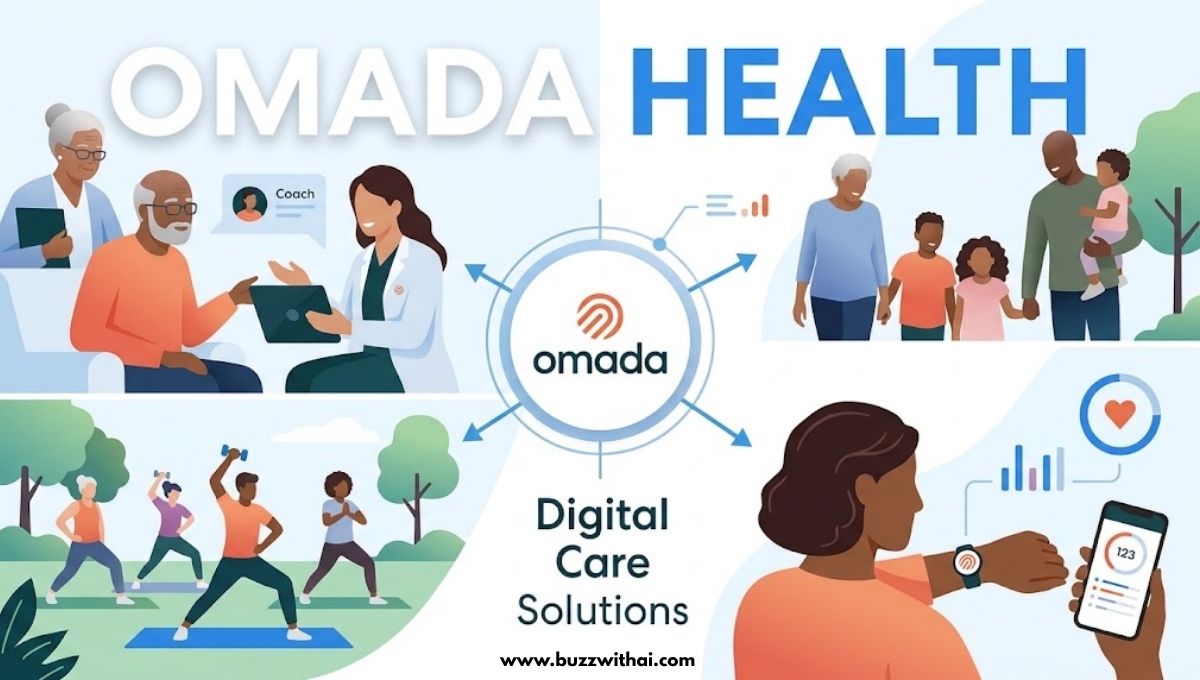
Most digital health companies chase growth and lose money doing it. Omada Health is doing something rarer: growing fast and making money at the same time. That combination is why investors, employers, and health plans are paying closer attention to this company than they were even a year ago.
If you’ve never heard of Omada Health before, here’s the short version: it’s a virtual care company that helps people manage chronic conditions like diabetes, high blood pressure, and obesity in the gap between doctor’s visits. If you have heard of it, the recent numbers alone are worth a second look Omada Health estimates its addressable market at more than $138 billion across five chronic conditions, and its latest earnings suggest it’s carving out a real piece of that pie.
This article breaks down what Omada Health actually does, how the company is performing financially, what’s driving its growth, and where it might be headed next. Along the way, we’ll add table in this article to make the numbers easy to compare, because frankly, spreadsheets communicate faster than paragraphs when you’re talking about margins and member counts.
What Is Omada Health?
Omada Health calls itself a “virtual between-visit healthcare provider.” That’s a mouthful, so let’s unpack it.
Think about a typical chronic condition, like type 2 diabetes or hypertension. You see your doctor maybe four times a year. In between those visits, you’re on your own managing medication, tracking symptoms, adjusting your diet, and trying to remember advice you got three months ago. That gap is where most chronic conditions actually get better or worse. Omada Health exists to fill it.
The company pairs human health coaches with connected devices (think smart scales, blood pressure cuffs, and glucose monitors) and a mobile app that tracks your progress over time. Instead of waiting for your next appointment to flag a problem, your data gets reviewed continuously, and a coach nudges you when something needs attention.
Here’s a simple way to picture it: imagine having a personal trainer, but one who also has access to your lab results, checks in with you weekly, and adjusts your plan based on real biometric data instead of guesswork. That’s roughly the Omada Health model, minus the gym membership.
The company’s core condition areas include:
- Diabetes prevention and management
- Hypertension (high blood pressure) management
- Weight health, including support for people using GLP-1 medications
- Cholesterol management, a newer addition to the platform
- Musculoskeletal support, rounding out its broader “cardiometabolic” focus
Crucially, Omada Health isn’t sold directly to consumers the way a fitness app might be. Instead, it works through employers, health plans, and pharmacy benefit managers (PBMs), who offer it as a covered benefit. You don’t buy Omada Health your employer or insurer typically does, on your behalf.
A Quick History and Where Omada Health Stands Today
Omada Health was founded on a fairly simple premise: chronic disease management shouldn’t require a hospital visit to work. Over the years, that premise expanded into a multi-condition platform serving over a million members.
The company went public on the Nasdaq under the ticker OMDA, and it recently passed the one-year mark as a public company. That’s a meaningful milestone in digital health, where plenty of newly public companies struggle to keep investors’ confidence once quarterly reporting begins.
In August 2026, Omada Health made a second kind of announcement alongside its earnings: a leadership transition. Co-founder and CEO Sean Duffy will step into the role of Founder and Executive Chair effective January 1, 2027, while current President Wei-Li Shao will take over as Chief Executive Officer.
Leadership transitions always raise questions, but this one reads more like succession planning than crisis management. Duffy isn’t leaving the company; he’s shifting into a chair role while staying involved, and Shao has been President already, meaning she’s had a front-row seat to the business heading into the top job. Still, any CEO change is worth watching, and we’ll come back to what it might mean for the company’s direction later in this piece.
The Numbers: Growth and the Profitability Turn
This is where Omada Health’s story gets genuinely interesting, so let’s slow down and go through it carefully.
In the first quarter of 2026, the company reported $78 million in revenue, up 42% year over year. Its net loss narrowed to $3 million, compared with a $9 million loss in the same quarter the year before. Adjusted EBITDA came in at $1 million, a sharp swing from an adjusted EBITDA loss of $4 million a year earlier. Cash and equivalents stood at $212 million.
Then came the second quarter, and the numbers jumped again this time crossing into full GAAP profitability. Revenue hit $88 million, up 43% year over year. Total members reached 1.1 million, a 45% increase from 752,000 members in the same period last year. Net income landed at $5 million, compared with a $5 million net loss in Q2 2025. Adjusted EBITDA came in at $11 million, versus a loss of just $0.2 million the year before.
Here’s a table breaking down the two most recent quarters side by side, since the shift between them tells you more than either number alone:
| Metric | Q1 2026 | Q2 2026 | Change |
|---|---|---|---|
| Revenue | $78 million | $88 million | Up 13% quarter over quarter |
| Year-over-year revenue growth | 42% | 43% | Roughly steady |
| Net income (loss) | ($3 million) | $5 million | Swung to positive |
| Adjusted EBITDA | $1 million | $11 million | Sharp increase |
| Total members | Not disclosed separately | 1.1 million | Up 45% year over year |
| Cash and equivalents | $212 million | $222 million | Up $10 million |
| GAAP gross margin | Not disclosed at same detail | 73% | Up from 66% a year earlier |
Two things jump out here. First, growth hasn’t slowed down at all revenue grew at roughly the same clip in both quarters. Second, and more importantly, profitability arrived without sacrificing that growth. That’s the part that tends to excite investors, because it’s the combination digital health companies have struggled to pull off for years.
Gross margin expansion tells a similar story. GAAP gross margin reached 73% in Q2 2026, up from 66% a year earlier, while non-GAAP gross margin climbed to 74%, up from 68%. In plain terms: Omada Health is spending less to serve each additional member than it used to, which is exactly what you want to see as a subscription-style healthcare business matures.
Trailing twelve-month revenue per total member grew about 2% year over year, landing at $284. That’s a modest increase, but it matters because it shows the company isn’t just adding cheaper, lower-value members to inflate its growth numbers existing member value is holding steady even as the base expands rapidly.
As Chief Financial Officer Steve Cook put it on the earnings call:
“We delivered another strong quarter, setting quarterly records for revenue of $88 million… marking Omada Health’s most profitable quarter to date, both in absolute terms and on a margin basis.”
Following that report, Omada Health raised its full-year guidance, which now points to roughly 30% year-over-year revenue growth and a fourfold increase in adjusted EBITDA at the midpoint. The market reacted quickly too shares rose nearly 6% in after-hours trading following the announcement, closing around $20.68.

What’s Driving Omada Health’s Growth
Numbers are one thing; understanding why they’re moving is another. A few forces are clearly behind Omada Health’s momentum right now.
GLP-1 and weight management demand. The explosion of GLP-1 medications (think Ozempic, Wegovy, and similar drugs) has reshaped the entire weight management industry, and Omada Health has positioned itself as a support layer around that trend rather than a competitor to it. Its weight health program helps members manage side effects, build sustainable habits, and stay engaged with treatment over time.
That said, this isn’t a one-directional tailwind. President Wei-Li Shao noted on the earnings call that while some employers are expanding weight loss benefits, others are “walking away” from GLP-1 coverage decisions during current evaluation cycles.
That’s a useful reality check employer appetite for covering expensive weight-loss drugs varies quite a bit, and Omada Health’s growth here isn’t guaranteed to be a straight line upward.
Multicondition expansion. Rather than staying a single-condition point solution, Omada Health has been layering additional care tracks onto its existing member base. In July 2026, the company launched its first deployment of a cholesterol management offering with one of the nation’s largest retailers. It also secured its first prescribing program contract, slated to launch in 2027.
Bigger payer partnerships. Omada Health broadened its relationship with Health Care Services Corporation (HCSC), extending its Prevention & Weight Health and Hypertension Management programs across HCSC’s fully insured book of business in Illinois, Oklahoma, and New Mexico. That single deal reaches an additional 1.5 million covered live a meaningful expansion of the company’s potential member pool without needing to sign up new logos from scratch.
Operational efficiency through AI. Management has pointed to increased capacity per care team member as a driver of margin improvement. Cost of revenue per member fell more than 10% year over year on a trailing twelve-month basis, which the company attributes in part to AI-assisted tools helping human coaches manage larger caseloads without sacrificing quality of care.
How Omada Health Compares to Competitors
Omada Health doesn’t operate in a vacuum. Digital chronic care is a genuinely crowded space, and it’s worth knowing where Omada Health fits relative to other players.
| Company | Primary Focus | Business Model | Notable Differentiator |
|---|---|---|---|
| Omada Health | Multicondition cardiometabolic care (diabetes, hypertension, weight, cholesterol) | B2B2C via employers, health plans, PBMs | Broad multicondition integration under one platform |
| Virta Health | Type 2 diabetes reversal | B2B2C via employers and health plans | Focused specifically on diabetes remission through nutrition |
| Teladoc (Livongo) | Chronic condition monitoring plus general telehealth | B2B2C, broader telehealth umbrella | Combines chronic care with general virtual visits |
| Vida Health | Multicondition, including mental health | B2B2C via employers and health plans | Integrates behavioral health alongside physical conditions |
| Noom (Health side) | Weight management, behavior change | Direct-to-consumer and B2B | Consumer app roots with strong behavioral design |
Omada Health’s edge tends to come from two things: its multicondition integration (managing several related conditions through one relationship rather than juggling separate vendors) and its increasingly deep payer relationships, which give it access to large, pre-existing member pools rather than needing to acquire consumers one at a time.
That said, competitors have real strengths too. Virta Health, for instance, has built a strong reputation specifically around diabetes reversal outcomes, and Teladoc’s scale in general telehealth gives it a much broader footprint outside of chronic care alone. No single company has “won” this space yet, and it’s genuinely competitive.
Who Omada Health Is Actually For
It’s easy to talk about revenue and margins and lose sight of the fact that Omada Health exists to help actual people manage actual health conditions. So who is this really built for?
Employers offering it as a workplace benefit, often bundled alongside broader wellness offerings, looking to reduce downstream healthcare costs tied to chronic disease.
Health plans and PBMs who want to offer members a virtual care option without building the infrastructure themselves.
Individual members, whose day-to-day experience typically looks something like this:
- You’re enrolled through your employer or health plan and receive a connected device (a smart scale, blood pressure cuff, or glucose monitor, depending on your program).
- You download the Omada Health app and complete an initial assessment.
- You’re matched with a dedicated health coach who checks in regularly.
- Your device syncs data automatically, so your coach sees trends without you needing to log everything manually.
- Over weeks and months, you get personalized nudges, encouragement, and adjustments based on your actual numbers.
Imagine you’ve just been diagnosed with hypertension. Instead of leaving your doctor’s office with a pamphlet and a follow-up appointment in three months, you get a blood pressure cuff in the mail, a coach who checks in weekly, and an app that shows you exactly how your numbers respond to changes in diet, exercise, or medication timing.
That immediate feedback loop is the core value proposition small adjustments, made consistently, rather than big changes made only during rare doctor visits.
Risks and Open Questions Worth Watching
No company’s story is without risk, and Omada Health has a few worth flagging honestly rather than glossing over.
- GLP-1 coverage uncertainty. As mentioned earlier, employer willingness to cover weight-loss medications is inconsistent right now, and that inconsistency could ripple into demand for Omada Health’s weight health track.
- Competitive pressure. The digital chronic care space is crowded, and differentiation isn’t permanent competitors can and do launch similar multicondition offerings.
- Execution risk during leadership transition. While Wei-Li Shao’s move to CEO looks like planned succession rather than upheaval, any top-level change carries some execution risk, especially for a company still scaling rapidly.
- Stock volatility. As a relatively newly public healthtech company, Omada Health’s shares have shown the kind of volatility typical of the sector the after-hours jump following Q2 earnings is a good example of how sensitive the stock is to quarterly results.
None of these risks are unusual for a company at this stage, but they’re worth keeping in mind before assuming the current growth trajectory is guaranteed to continue indefinitely.
What’s Next for Omada Health
A few near-term events are worth marking on your calendar if you’re following this company closely.
Omada Health is scheduled to host its first Investor Day on September 10, 2026, which should offer a more detailed look at long-term strategy beyond quarterly earnings snapshots. Investor Days often reveal roadmap details that don’t come up in standard earnings calls, so this is likely to be a meaningful moment for anyone tracking the company’s next phase.
Beyond that, expect continued expansion of the cholesterol management track following its initial retail deployment, along with the company’s first prescribing program contract, which is set to launch in 2027.
Combined with the pending CEO transition at the start of that same year, 2027 is shaping up to be a pivotal year for Omada Health one where the company needs to prove its recent profitability wasn’t a temporary high point, but a sustainable new baseline.
Final Thoughts
Omada Health’s story right now isn’t the classic “promising healthtech startup burning cash to chase growth” narrative that’s defined so much of digital health over the past decade. It’s something more unusual: a company that’s growing at over 40% year over year while simultaneously turning profitable, expanding into new conditions, and deepening its relationships with major payers.
That doesn’t mean the road ahead is risk-free GLP-1 coverage decisions, competitive pressure, and a looming leadership change are all real variables to watch. But for a sector that’s struggled to prove out sustainable unit economics, Omada Health’s recent quarters offer a genuinely compelling case study in what “growing up” can look like for a digital health company.
If you’re an investor, an employer benefits manager, or simply someone curious about where chronic care is headed, Omada Health is worth keeping on your radar heading into its first Investor Day and the leadership handoff planned for 2027.
