

V7
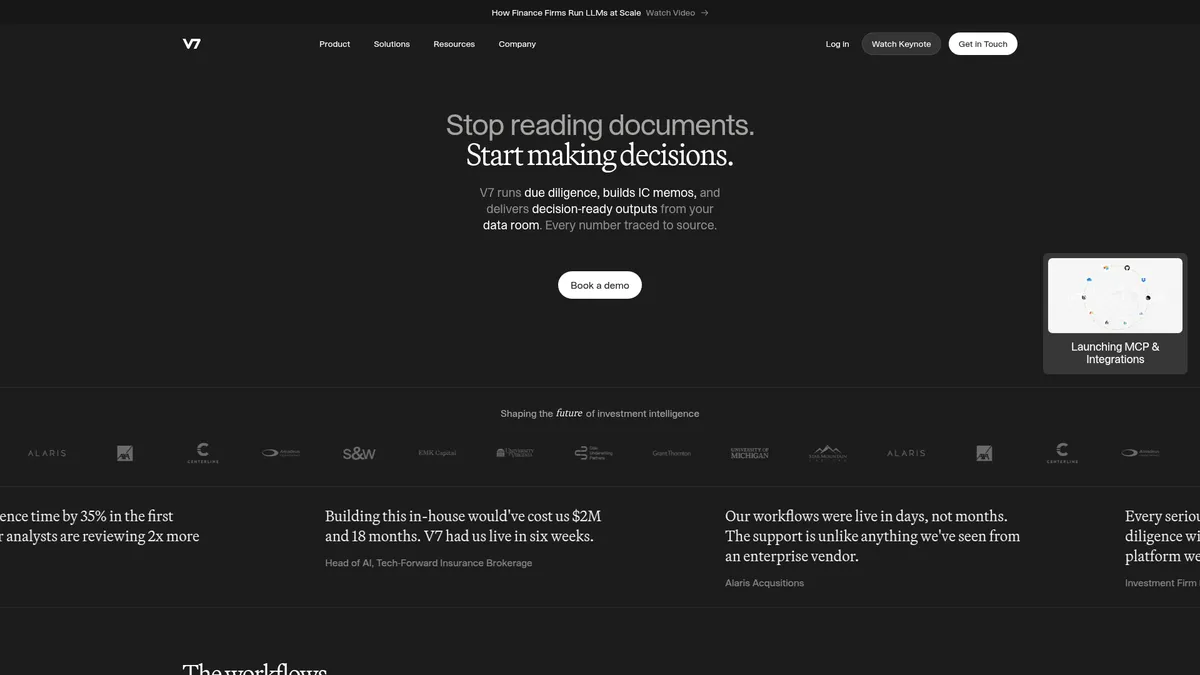
AI-powered due diligence and deal workflow platform
What is V7?
How to Use V7
Getting started with V7 is designed to be fast and non-disruptive. The platform integrates with your existing data sources and workflows, so you can go from sign-up to your first automated due diligence report in just a few weeks. Here's how to get up and running.
Connect Your Data Sources
Link your data rooms, OneDrive, SharePoint, CRM, and other document repositories to V7 using its integration hub or API. The platform supports 300+ native connectors for seamless data ingestion without manual uploads or file transfers.
Choose or Build Your AI Agents
Select from 280+ pre-built industry agents for finance, legal, insurance, or risk analysis. Alternatively, use the custom agent builder to design AI assistants tailored to your specific workflow requirements and document types.
Ingest and Process Documents
Upload or sync documents from your connected sources. V7 automatically extracts financial, legal, and commercial terms, linking every data point back to its original source with full traceability for compliance and audit purposes.
Generate Deliverables
Use the platform to automatically produce IC memos, slide decks, spreadsheets, and PDF reports. Customize outputs to match your firm's templates and formatting standards, then review and approve before distribution.
Review and Collaborate
Review generated outputs with your team using real-time collaboration features. Sync finalized deliverables back to OneDrive or SharePoint for easy access, and track changes with full version history and audit logging.
V7 Core Features
V7 Use Cases
- 1Private Equity Due Diligence - Investment teams use V7 to automate the review of CIMs, financial statements, and legal contracts during deal sourcing. The platform extracts key metrics, identifies risks, and generates IC memos in minutes instead of weeks, freeing analysts for higher-value strategic work.
- 2Corporate M&A Workflow - M&A teams deploy V7 to manage end-to-end deal processes, from target identification through document analysis to board presentations. It ingests data from multiple sources and produces structured deliverables automatically, cutting weeks off typical deal timelines.
- 3Contract Analysis for Legal Teams - Legal departments leverage V7's AI agents to review contracts, extract key terms and obligations, and flag risks. The source-linked outputs provide an auditable trail for compliance and regulatory review, reducing manual review time by over 90%.
- 4Insurance and FinTech Document Processing - Insurance firms use V7 to automate analysis of policies, claims, and regulatory filings. The platform extracts structured data from complex documents and feeds it into downstream systems, improving processing speed by 21x with fewer errors.
- 5Real Estate Investment Screening - Real estate investors employ V7 to rapidly screen property acquisition documents, extract risk factors, and generate investment committee reports with traceable data points, enabling faster go/no-go decisions on potential acquisitions.
Pros and Cons of V7
Pros
- Dramatic Time Savings - V7 reduces typical due-diligence cycles from 100+ hours to under 10 hours, and CIM-to-IC-memo generation from 5-7 hours to just 15 minutes, freeing teams for higher-value analysis and faster deal execution.
- Auditable Source-Linked Outputs - Every extracted data point is linked back to its original source document, creating a fully traceable audit trail that satisfies strict compliance and regulatory requirements for investment committees.
- Extensive Pre-Built Agent Library - With over 280 ready-to-use AI agents spanning finance, insurance, legal, and risk, teams can deploy industry-specific automation immediately without spending months building custom models.
- Massive Cost Reduction - Clients report data-analysis costs dropping from $2.5 million to $100,000 per year, with 54% fewer errors and 21x faster processing compared to manual methods, delivering rapid ROI for high-volume deal teams.
✕ Cons
- Undisclosed Custom Pricing - V7 does not publish pricing publicly, requiring potential customers to go through a demo and sales process to get a quote, which can slow down initial evaluation and budget planning for procurement teams.
- Learning Curve for Legacy Teams - Teams accustomed to traditional manual due-diligence processes may need training and change management to fully adopt the platform's AI-driven workflows and build trust in automated outputs.
- Edge-Case Accuracy Risks - While V7 dramatically reduces errors overall, highly complex or non-standard documents with unusual formatting may still require human review, meaning it's not a complete replacement for expert judgment in every scenario.
V7 vs Top Alternatives
| Feature | Ansarada | Datasite | iDeals |
|---|---|---|---|
| Document Ingestion & AI Extraction | AI-powered data rooms with document Q&A and smart search | Virtual data room with manual document indexing and search | Secure document sharing with smart search and Q&A workflows |
| Pre-Built AI Agent Library | Limited pre-built AI workflows for deal management | No dedicated AI agent ecosystem for specialized tasks | No pre-built AI agents for specialized verticals |
| Source-Linked Audit Trail | Standard compliance tracking and version control | Basic activity audit and document tracking | Standard audit logging and access tracking |
| Pricing Transparency | Public tiered pricing starting from $295/month | Custom enterprise-level pricing (not publicly disclosed) | Transparent tiered pricing starting from $45/month |
V7 Pricing
Custom Plan
- Platform access to V7 Go core engine
- 280+ pre-built AI agents for finance, insurance, legal, and risk
- Custom agent builder for bespoke workflows
- Integration hub with 300+ connectors via MCP or API
- User role management with granular permissions
- Source-linked audit trail for compliance
- Real-time collaboration and deliverable sync
- Enterprise support with dedicated Solutions Engineer
V7 FAQ
What is V7 and who is it for?+
How does V7 handle data security and confidentiality?+
What types of documents can V7 process?+
Does V7 integrate with existing tools?+
How long does it take to implement V7?+
What is the pricing model for V7?+
How much faster is due diligence with V7?+
V7 Review — Editor's Score
Who Should Use V7?
V7 is ideal for private equity firms, investment banks, corporate M&A teams, legal departments, insurance companies, and financial institutions that regularly process large volumes of complex business documents and need auditable, source-linked outputs with minimal turnaround time.
V7 is a powerhouse for institutional investment teams that need to process massive volumes of deal documents with speed and accuracy. Its 280+ pre-built agents and source-linked outputs set it apart from generic document AI tools. While custom pricing and a learning curve for traditional teams are drawbacks, the ROI for high-volume deal shops is undeniable. If you're in private equity, M&A, or corporate finance and still doing due diligence manually, you're leaving money on the table.
- Reduces due-diligence time from 100+ hours to under 10 hours
- 280+ pre-built AI agents for finance, legal, insurance, and risk
- Every data point source-linked for full audit trail compliance
- Integrates with 300+ enterprise tools via MCP and API
📺 V7 Tutorials & Introduction
Introducing AI Agents: Examples & Use Cases | V7 Go Keynote
Getting Started with V7 Darwin | Introduction to the Annotation ...
Annotate Automatically With Model Tools | V7 Darwin Tutorial
Keywords: