

Undermind
AI co-researcher for scientific literature discovery
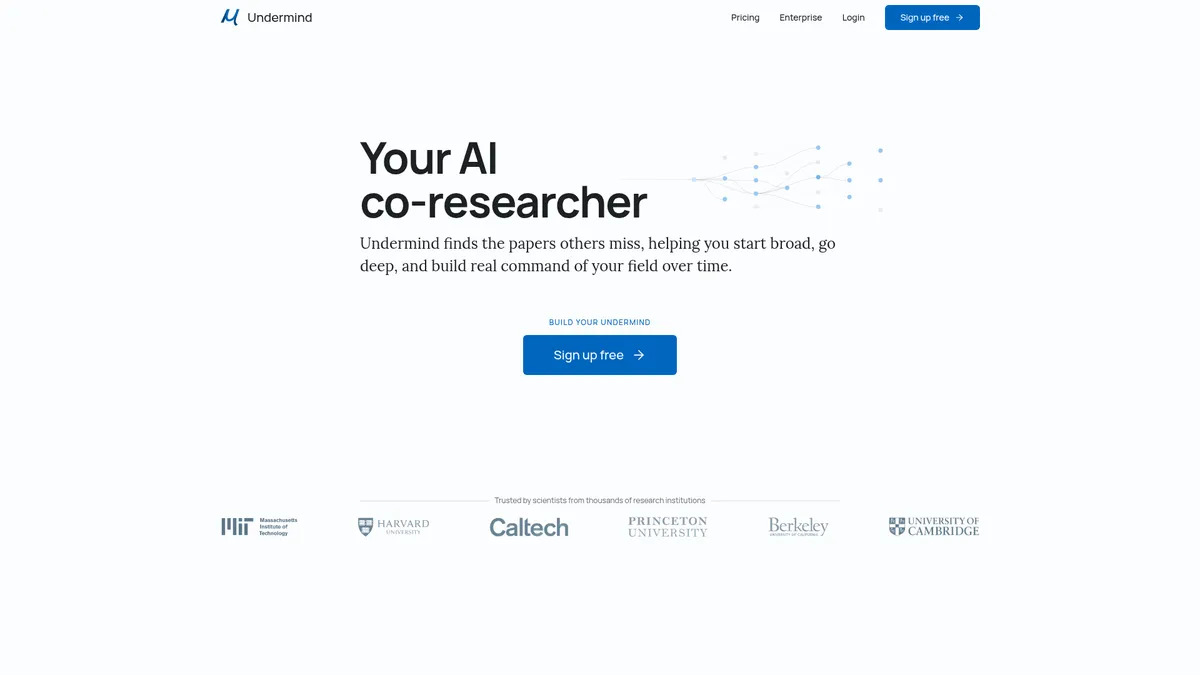
What is Undermind?
How to Use Undermind
Undermind makes scientific literature discovery feel like having a conversation with an expert research assistant. Here's how to get started with your first deep literature search.
Describe your research problem
Open Undermind and type a description of your research question or problem in plain language. Be as specific as you like — the AI will ask follow-up questions to clarify your intent and narrow the focus before launching the search.
Review and refine with the AI
Answer the AI's clarifying questions to refine your search parameters. This conversational step ensures the system understands exactly what you're looking for, dramatically improving the relevance of results compared to a simple keyword search.
Explore the deep literature results
Browse the search results, which include relevance scores, in-line citations, and sortable tables. Use the custom table generator to compare methods, datasets, or findings side by side. Follow citation trails to uncover papers the initial search may have missed.
Build your report and set up alerts
Use the chat interface to iteratively refine your findings into a structured report with cited evidence. Once your project is set up, enable real-time alerts to receive notifications when new papers matching your topic are published.
Undermind Core Features
Undermind Use Cases
- 1Novelty assessment — Quickly verify if a research idea has already been published by searching across hundreds of papers and following citation trails to ensure you're exploring genuinely new territory.
- 2Literature review and report drafting — Produce structured, cited summaries of a field by describing your topic, letting the AI crawl relevant papers, and refining the output through conversational chat until you have a publication-ready review.
- 3Cross-disciplinary insight generation — Discover unexpected connections between separate scientific domains by exploring literature outside your core field, surfacing methods or findings that could translate to your research.
- 4Research bottleneck solving — Locate specific methods, datasets, or prior solutions relevant to a technical problem you're facing, dramatically cutting down the time spent hunting for the right paper.
- 5Continuous research monitoring — Set up real-time alerts to track new publications matching your project's focus areas, ensuring you never miss a critical advance or competing discovery.
Pros and Cons of Undermind
Pros
- Dramatically higher recall than traditional academic search engines like Google Scholar, finding up to 10x more relevant papers per query by reading full-text content and following citation trails.
- End-to-end workflow that takes you from describing a research problem all the way to building structured reports with cited evidence and setting up ongoing monitoring alerts.
- Transparent and verifiable citations for every claim with in-line linking to source papers, making it easy to fact-check and dive deeper into specific findings.
- Enterprise-grade security with strict guarantees that your data is never used to train models, plus clear IP ownership and encryption standards suitable for commercial R&D teams.
✕ Cons
- Paid tiers may feel expensive for individual researchers or small labs with limited budgets, especially the Team plan which requires a minimum of five seats.
- Free tier imposes standard rate limits that can restrict heavy or frequent usage, making it more of a trial than a viable long-term option for power users.
- Service depends on third-party large language model providers, meaning any outages or performance issues on their end can directly affect Undermind's availability and response quality.
Undermind vs Top Alternatives
| Feature | Google Scholar | Semantic Scholar | Elicit |
|---|---|---|---|
| Conversational AI search | Basic keyword matching search | NLP-enhanced keyword search | Direct question answering with AI |
| Citation trail expansion | Limited citation graph traversal | Limited citation graph features | Citation list generation only |
| Relevance scoring and filtering | Sort by date or relevance only | Influence-based relevance scoring | Paper relevance scoring available |
| Real-time publication alerts | No native real-time alerts | API-based alerts, no native UI | No native real-time alerts |
Undermind Pricing
Free
- Basic AI chat interface
- Standard search limits
- Shared projects
- Basic alerts
Pro
- Latest AI models for full-text analysis
- 10x higher search limits
- Unlimited projects, files and paper library
- Deepest full-text analysis
Team
- All Pro features for each member
- Team management and shared projects
- Priority customer support
- Centralized billing (min. 5 seats)
Enterprise
- All Team features
- Org-wide SSO and admin dashboard
- Dedicated support and onboarding
- Custom SLA and security review
Undermind FAQ
What is Undermind and how does it work?+
How is Undermind different from Google Scholar?+
Who is Undermind best suited for?+
What pricing plans are available?+
Does Undermind offer a free tier?+
Is my data safe and private with Undermind?+
Can I use Undermind for team collaboration?+
Undermind Review — Editor's Score
Who Should Use Undermind?
This is built for PhD students, postdocs, academic researchers, biotech R&D teams, and corporate innovation labs who need to conduct thorough literature reviews, monitor emerging research, or find cross-disciplinary connections. If your work involves any serious engagement with scientific papers, Undermind will save you hours every week.
Undermind is a genuine leap forward for anyone who regularly battles the academic literature. Its conversational interface and deep full-text analysis uncover papers that even well-crafted Google Scholar queries miss. The 10x recall claim feels plausible after using it, and the transparent citation linking builds trust in the results. While the pricing may give solo researchers pause, the free tier offers enough to test its mettle, and the Team/Enterprise plans are well-priced for organizations that depend on staying current with research.
- 10x better recall than Google Scholar for scientific literature
- Conversational AI that refines research intent before searching
- End-to-end workflow from problem description to published report
- Enterprise-grade security with IP ownership guarantees
📺 Undermind Tutorials & Introduction
AI Essentials: Lit Reviews with Undermind - YouTube
This AI Tool Finds Research Papers 100x Faster (Literature Reviews ...
Undermind AI: The Smartest AI Tool for Finding Research Papers ...
Keywords: