

Subtxt
AI-powered narrative design for story architects
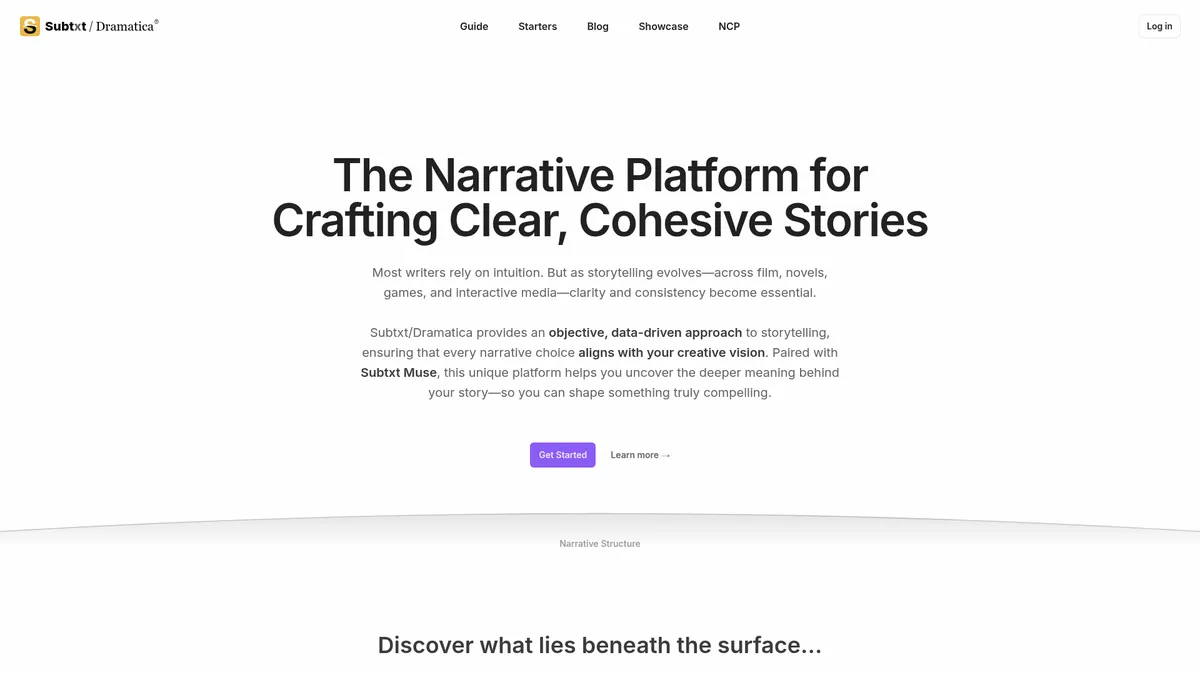
What is Subtxt?
How to Use Subtxt
Subtxt can seem complex at first, but getting started is straightforward. Follow these steps to begin building your story with AI-powered narrative analysis and Dramatica theory. The platform guides you from initial structure to final story map.
Create Your Account and Choose a Plan
Visit subtxt.app and sign up for a Dramatica Basic, Pro, or Infinite plan. Choose the tier that matches your needs—Basic at $20 per month for individual writers, Pro at $55 per month for advanced features like HD media and story weaving, or Infinite at $250 per month for full API access and dedicated onboarding.
Select a Storyform from the Library
Browse the library of 32,000+ narrative structures or start with one of 650+ example storyforms. These pre-built frameworks provide the foundation for your story's character relationships, plot points, and thematic elements. You can also create a custom storyform from scratch.
Activate Your AI Muse Agents
Engage the AI Muse agents—Theory, Storyforming, Research, and Assistant—to analyze your story's coherence. Each agent offers different insights: Theory teaches Dramatica concepts, Storyforming helps build narrative architecture, Research evaluates story data, and Assistant provides general creative support.
Map Your Narrative with the Argument Builder
Use the Subtxt Argument Builder to visually connect character arcs, plot developments, and themes. This interactive tool shows you how each decision impacts overall story cohesion, helping you identify and resolve inconsistencies before they become problems in your draft.
Experiment in Dramatica Play Mode
Switch to Dramatica Play Mode to test different story variations in a sandbox environment. Experiment with alternative character choices, plot twists, or thematic shifts without affecting your primary narrative. Once satisfied, use story weaving to generate act and scene sequences automatically.
Subtxt Core Features
Subtxt Use Cases
- 1Screenwriters and novelists use Subtxt to objectively analyze story coherence, identify hidden inconsistencies in plot logic, and strengthen character arcs using data-driven Dramatica theory. The AI Muse agents provide real-time feedback on conflict causality and thematic weight, helping authors refine their narratives before committing to a full draft.
- 2Narrative designers for video games and interactive experiences rely on Subtxt to maintain logical story continuity across branching paths and complex character relationships. The platform's structural analysis ensures that player choices remain meaningful within a coherent overall framework, preventing narrative contradictions.
- 3Producers and studio executives evaluate script viability early in development by using Subtxt to spot structural weaknesses and thematic imbalances. The mathematical analysis provides objective data points for greenlighting decisions, reducing reliance on subjective intuition alone.
- 4AI-driven storytelling pipelines leverage the open-source Narrative Context Protocol (NCP) to ensure consistent authorial intent across multiple AI agents. Teams working with plot generators, dialogue bots, and world-building tools can maintain a unified narrative vision throughout production.
- 5Educators and students of narrative theory explore Dramatica concepts with Subtxt's AI-enhanced examples and instant feedback. The massive library of pre-built storyforms serves as a living textbook, allowing learners to see how structural changes impact overall story cohesion.
Pros and Cons of Subtxt
Pros
- Objective, mathematically-backed narrative analysis reduces guesswork and helps writers make confident structural decisions grounded in Dramatica theory.
- Integrated AI Muse agents provide both analytical insights (conflict mapping, causality tracking) and creative inspiration without overriding the author's personal voice.
- Massive library of 32,000+ pre-built storyforms accelerates the ideation process, giving writers instant access to proven narrative frameworks.
- Tiered pricing structure allows solo writers to start at $20/month while large studios can access premium features, API integration, and dedicated onboarding.
✕ Cons
- Steep learning curve for writers unfamiliar with Dramatica theory requires significant upfront time investment to fully leverage the platform's capabilities.
- Higher-tier plans at $55 and $250 per month are relatively expensive for independent creators and hobbyists with limited budgets.
- AI-driven suggestions can sometimes feel prescriptive, and the full manual Dramatica experience requires waiting for the upcoming No-AI plan.
Subtxt vs Top Alternatives
| Feature | Scrivener | Final Draft | Save the Cat! | Plottr |
|---|---|---|---|---|
| AI-driven narrative analysis | No AI analysis capabilities | No AI-powered analysis tools | Beat sheet evaluation only | No AI narrative analysis |
| Pre-built story structure library | Basic document templates only | Industry formatting templates | 15-beat structure library | Visual plotting templates |
| Dramatica theory framework | No Dramatica support | No Dramatica integration | Partial beat-based methodology | No Dramatica framework |
| Multi-agent AI collaboration | No AI collaborative features | Human co-writing only | No multi-agent capabilities | No AI workflow support |
Subtxt Pricing
Dramatica Basic
- 32,000+ narrative structures
- 650+ example storyforms
- All Muse agents (Theory, Storyforming, Research, Assistant)
- 1 file upload per chat
- 2GB document storage
- Four Throughlines & Plot analysis
- Single customizable Muse persona
Dramatica Pro
- Everything in Dramatica Basic
- HD image generation
- HD voice response
- 2x memory context multiplier
- Multiple file uploads per chat
- 10GB document storage
- Multiple Muse personas
- Full character arc and storypoints analysis
- Automatic story weaving
- Dramatica Play Mode
Dramatica Infinite
- Everything in Dramatica Pro
- Maximum memory context
- 6x document retrieval multiplier
- 20GB document storage
- 1:1 onboarding
- Full API access
No-AI Dramatica (coming soon)
- Same structural library
- Manual Story Engine settings
- Video tutorials
- No AI assistance
Subtxt FAQ
What is Subtxt and how does it differ from other writing tools?+
Do I need to know Dramatica theory to use Subtxt?+
What are AI Muse agents and how do they help with writing?+
Can I use Subtxt for collaborative projects?+
Is there a free version or free trial of Subtxt?+
What is the Narrative Context Protocol (NCP)?+
Can I export my work from Subtxt to other writing software?+
Subtxt Review — Editor's Score
Who Should Use Subtxt?
Screenwriters, novelists, narrative designers, and story editors who want objective, data-backed analysis of their story's coherence and are willing to invest time in learning Dramatica theory. Also ideal for studios building AI-driven storytelling pipelines with the Narrative Context Protocol.
Subtxt is a powerful narrative design platform that brings data-driven rigor to storytelling. While the learning curve is steep and the pricing may deter casual writers, its combination of Dramatica theory and AI Muse agents offers unmatched structural analysis for serious story architects. If you're committed to mastering story structure, Subtxt is an invaluable tool that delivers clarity and confidence in narrative construction.
- Combines Dramatica theory with AI Muse agents for objective story analysis
- Library of 32,000+ pre-built narrative structures accelerates ideation
- Narrative Context Protocol enables consistent multi-agent AI storytelling workflows
📺 Subtxt Tutorials & Introduction
Using Subtxt to Write Short Stories - YouTube
Introduction to Narrative Agents - YouTube
Finding the Source of Conflict in Your Obstacle Character ... - YouTube
Keywords: