
SmythOS
Open-source OS for building and deploying AI agents at scale
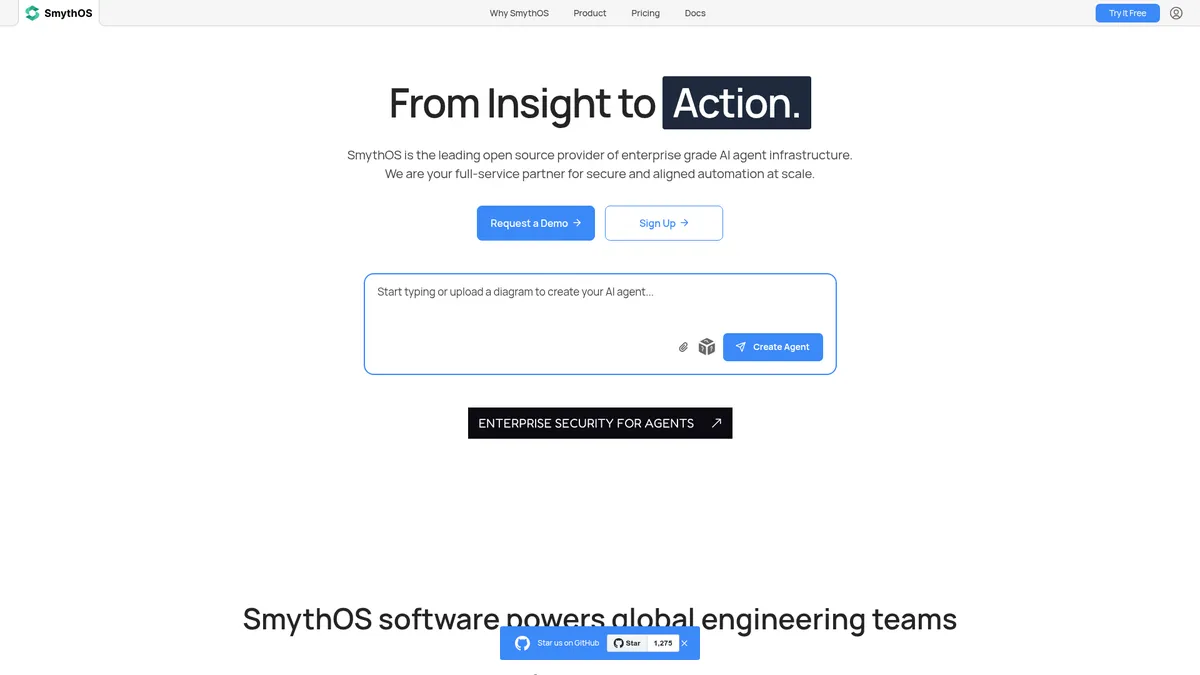
What is SmythOS?
How to Use SmythOS
Get started with SmythOS quickly using this step-by-step guide. Whether you prefer visual workflows or code-first development, SmythOS's unified platform lets you build, test, and deploy AI agents in minutes.
Install and Launch SmythOS Studio
Download the free Docker image from SmythOS's repository or sign up for the hosted SaaS version to get instant access. Once launched, the Agent Studio interface greets you with a visual canvas ready for building workflows.
Build Your Agent Workflow
Use the drag-and-drop canvas to connect triggers, AI models, data sources, and actions into a complete agent workflow. The Agent Weaver feature lets you mix text and image interactions, while the template library provides pre-built blueprints for common use cases like support and research.
Configure Security and Governance
Set up access controls, human-in-the-loop approval gates, and audit logging to ensure compliant agent operation. Define policy rules and resource-level permissions using the built-in governance dashboard that enforces security across all deployed agents.
Deploy and Monitor Your Agent
Deploy your agent to any target environment—cloud, on-prem, edge, or desktop—with one click from the Studio. Use the observability suite to trace reasoning steps, monitor performance metrics, and debug issues in real-time as your agent operates in production.
SmythOS Core Features
SmythOS Use Cases
- 1Enterprise AI Workforce Automation: Deploy autonomous AI agents to automate repetitive business processes across departments while maintaining full auditability and human oversight. SmythOS's governance layer ensures compliance with industry regulations, making it ideal for finance, healthcare, and legal sectors.
- 2Secure Multi-Tenant AI Platforms: Build and manage AI-powered internal tools for large organizations with strict data isolation between teams, clients, or projects. The platform's built-in multi-tenancy and resource-level access control make it suitable for SaaS providers and enterprise IT departments.
- 3Edge and Air-Gapped AI Deployments: Run autonomous agents in environments with limited or no internet connectivity, such as manufacturing floors, military operations, or remote facilities. SmythOS supports deployment on edge devices and standalone executables with GPU-optional configurations.
- 4Rapid AI Agent Prototyping to Production: Accelerate the journey from proof-of-concept to production-grade AI agents using the single specification that works across Studio, SDK, and CLI. Teams can prototype visually, then deploy without rewriting code across different environments.
- 5Centralized AI Model and API Integration: Connect and orchestrate heterogeneous AI models, APIs, and data sources through a unified connector layer, eliminating vendor lock-in. This enables organizations to mix and match LLMs, vector databases, and external tools within a single governed workflow.
Pros and Cons of SmythOS
Pros
- End-to-end stack eliminates tool fragmentation: SmythOS combines runtime, SDK, visual IDE, and services in one platform, so teams don't need to piece together multiple tools to build and deploy AI agents.
- Enterprise-grade security and governance baked in: With sandboxing, ACLs, encryption, human-in-the-loop approvals, and audit logs, SmythOS is built from the ground up for regulated industries and sensitive workloads.
- Open-source core with flexible deployment options: The MIT-licensed core ensures transparency and community contributions, while paid options for SaaS, on-prem, and OEM give organizations deployment flexibility.
- Multi-environment support for maximum flexibility: Deploy agents anywhere—cloud, on-prem, edge, desktop, mobile, or air-gapped—without changing your code, making it suitable for diverse operational needs.
✕ Cons
- Pricing transparency is limited: Enterprise and SaaS pricing requires contacting sales, making it difficult for small teams to budget without going through a negotiation process.
- Steep learning curve for agent-centric development: The platform's breadth and focus on autonomous agent architectures can be overwhelming for teams new to AI agent development, requiring significant upfront investment in learning.
- Documentation and community resources are still maturing: While the core is open-source, comprehensive public documentation, tutorials, and community examples may not yet match the depth of more established open-source projects.
SmythOS vs Top Alternatives
| Feature | LangChain | AutoGPT | CrewAI | Dify.ai |
|---|---|---|---|---|
| Open-source license | Yes (MIT) | Yes (MIT) | Yes (MIT) | Yes (Apache 2.0) |
| Visual workflow builder | No (code-first SDK) | No (CLI & API only) | No (code-first framework) | Yes (drag-and-drop) |
| Built-in governance & audit | Limited (requires add-ons) | No built-in governance | Enterprise tier adds governance | Basic access controls |
| Multi-environment deployment | Cloud & Python environments | Desktop & cloud | Python-based deployments | Cloud & self-hosted |
SmythOS Pricing
Open Source (MIT)
- Agent Runtime (SRE)
- Agent SDK
- CLI tools
- Studio Docker image
- Community support
SaaS Hosted
- Managed cloud infrastructure
- All open-source features
- Hosted agent execution
- Support SLA
Enterprise On-Prem
- On-premise deployment
- OEM licensing options
- Custom integrations
- Professional services
- Dedicated support
SmythOS FAQ
What is SmythOS and how does it differ from other AI agent platforms?+
Is SmythOS completely free to use?+
What deployment environments does SmythOS support?+
Can SmythOS be used for regulated industries like healthcare and finance?+
Does SmythOS require coding skills to use?+
What kind of organizations currently use SmythOS?+
How does SmythOS handle multi-agent coordination?+
SmythOS Review — Editor's Score
Who Should Use SmythOS?
Engineering teams and enterprises that need to build, deploy, and manage autonomous AI agents at scale with strict security, governance, and multi-environment support. Best suited for organizations in regulated industries or those requiring edge and on-prem deployments.
SmythOS is the most complete open-source agent operating system we've tested. It delivers enterprise-grade infrastructure that competitors can't match, especially in governance and deployment flexibility. The learning curve is real, but for teams building production AI workforces, it's worth the investment.
- Open-source MIT license with flexible enterprise options
- End-to-end stack eliminates tool fragmentation
- Enterprise-grade security and governance built into runtime
- Multi-environment support from cloud to edge to air-gapped
📺 SmythOS Tutorials & Introduction
SmythOS - Customer Review Analysis - YouTube
How to Make Money with AI Agents (Step by Step Tutorial Using ...
Shopify AI Agent Tutorial (Build in Under 5 Minutes with SmythOS
Keywords: