
Peloton
Unified data platform for upstream energy operations
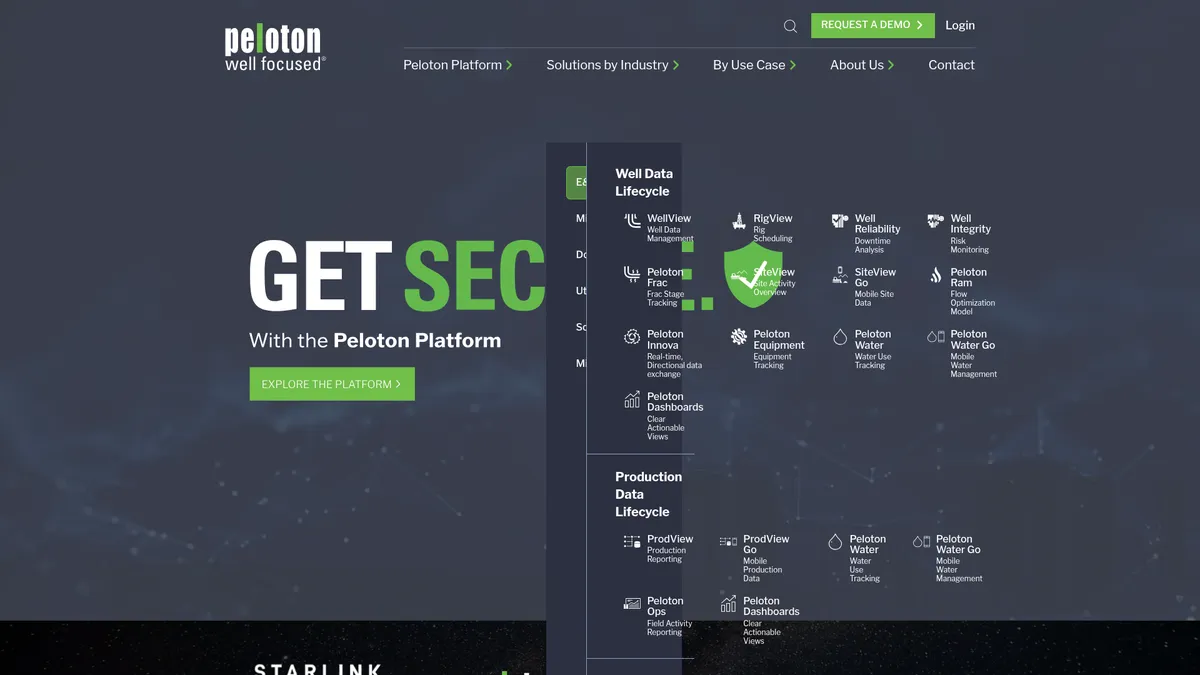
What is Peloton?
How to Use Peloton
Peloton's modular platform can be tailored to your specific energy workflows. Here's a step-by-step guide to getting started with Peloton for daily drilling and production reporting, leveraging its mobile-first design and AI-powered data validation.
Set Up Your Workspace and User Permissions
Configure your Peloton instance by selecting the modules relevant to your operations — such as WellView for drilling, ProdView for production, and LandView for land management. Define user roles and permissions to control access to sensitive data across your organization.
Connect and Integrate Data Sources
Use Peloton's API layer to connect existing ERP, SCADA, and GIS systems. Set up automated data ingestion pipelines to pull in well files, production volumes, and land records from legacy databases, spreadsheets, and third-party sources.
Deploy Mobile Field Data Collection
Install Peloton's mobile-optimized interface on field tablets and smartphones. Configure offline-capable forms for daily drilling reports, production volumes, and equipment inspections. Train field operators to capture data in remote locations with automatic sync when connectivity returns.
Activate AI Data Quality Monitoring
Enable Peloton Innova to automatically validate incoming data against custom rules and historical patterns. Configure anomaly detection thresholds and set up notifications for data stewards when issues are flagged. Review and approve suggested corrections through the built-in workflow.
Build Dashboards and Real-Time Reports
Use Peloton Dashboards to create visualizations for drilling progress, production trends, well integrity metrics, and land portfolio analysis. Configure drill-through capabilities so users can click from high-level summaries to granular field data for detailed investigation.
Peloton Core Features
Peloton Use Cases
- 1Drilling & Completions Management: Standardize daily reporting across rigs with WellView, reducing manual entry and improving data quality for drilling engineers and completions teams.
- 2Production Operations Oversight: Monitor daily volumes, equipment performance, and hydrocarbon allocation across multiple fields using ProdView dashboards and real-time alerts.
- 3Hydraulic Fracturing Data Centralization: Aggregate and validate disparate vendor data during completions with Peloton Frac, ensuring consistent input and streamlined collaboration.
- 4Asset Integrity Monitoring: Track casing and annular pressures, inspection histories, and well status for aging wells using Well Integrity to prevent failures and extend asset life.
- 5Renewables Project Planning: Accelerate solar, wind, and geothermal land-use analysis and permitting with specialized LandView and Map extensions for renewable energy projects.
Pros and Cons of Peloton
Pros
- Comprehensive modular suite covers the entire upstream energy data lifecycle — from drilling and completions to production, land management, and renewables — eliminating the need for multiple disjointed systems.
- AI-powered data quality engine (Innova) proactively detects anomalies and suggests corrections, ensuring high-integrity data for analytics and regulatory reporting.
- Mobile-first design with offline capability enables field operators to capture and sync data from remote locations without internet connectivity.
- Integrated geospatial analytics (Peloton Map) provides spatial context to asset data, helping land and field teams visualize boundaries, tracts, and stakeholder relationships.
✕ Cons
- Opaque pricing requires contacting sales for a quote, making it difficult for potential buyers to evaluate cost without a time-consuming procurement process.
- The breadth of modules and features creates a steep learning curve, requiring significant training investment to fully leverage the platform's capabilities.
- Primarily cloud-only deployment may be a barrier for highly regulated environments or companies with strict on-premise data residency requirements.
Peloton vs Top Alternatives
| Feature | WellEz | P2 BOLT | Quorum Software | Enertia |
|---|---|---|---|---|
| AI Data Quality Engine | Basic validation rules only | Manual data review processes | Third-party AI integrations | No AI capabilities |
| Mobile Offline Capture | Offline mobile forms available | Mobile app with limited offline | Web-based only, no offline | No mobile offline support |
| Built-in Geospatial Analytics | No built-in geospatial tools | External GIS integration required | Separate GIS product offering | No GIS integration |
| Modular Suite Coverage | Standalone well reporting | Well lifecycle modules | Full upstream suite | ERP-focused modules |
Peloton Pricing
Core
- WellView
- ProdView
- Basic dashboards
- Email support
- Single user access
Professional
- All Core features
- Peloton Frac
- Peloton Innova AI
- Peloton Map
- API access
- Mobile field capture
- Phone support
- Up to 50 users
Enterprise
- All Professional features
- LandView
- Well Integrity
- Well Reliability
- Peloton Water
- Peloton Equipment
- Peloton RAM
- RigView
- SiteView
- Renewables Extension
- Dedicated support
- On-site training
- Unlimited users
Peloton FAQ
What is Peloton and who is it for?+
How does Peloton's AI-powered data quality engine work?+
Can Peloton be used offline in remote field locations?+
What modules are included in the Peloton platform?+
Does Peloton support renewable energy projects?+
How does Peloton integrate with existing enterprise systems?+
Is Peloton's pricing publicly available?+
Peloton Review — Editor's Score
Who Should Use Peloton?
Energy companies managing complex upstream workflows across drilling, production, and land operations — from mid-sized independents to large multinational operators. It's also well-suited for renewable energy firms expanding into solar, wind, or geothermal projects that need robust land management and geospatial tools.
Peloton delivers a truly comprehensive data platform for energy operations, unifying well, production, and land data in ways few competitors can match. The AI-powered data quality engine and mobile-first design are standout features that address real industry pain points. While the opaque pricing and steep learning curve may deter smaller operators, enterprises with complex upstream workflows will find immense value in Peloton's integrated approach.
- AI-driven data quality engine automates anomaly detection across all data streams
- Mobile-first design with offline field data capture for remote operations
- Comprehensive modular suite covering well, production, land, and renewables
- Integrated geospatial analytics brings spatial context to asset data
📺 Peloton Tutorials & Introduction
Peloton Interactive Describes How to Develop an Embedded Vision ...
Meet Peloton IQ - YouTube
Easily add apps to your Peloton with OpenPelo - YouTube
Keywords: