
Firecrawl
Web data infrastructure for AI agents
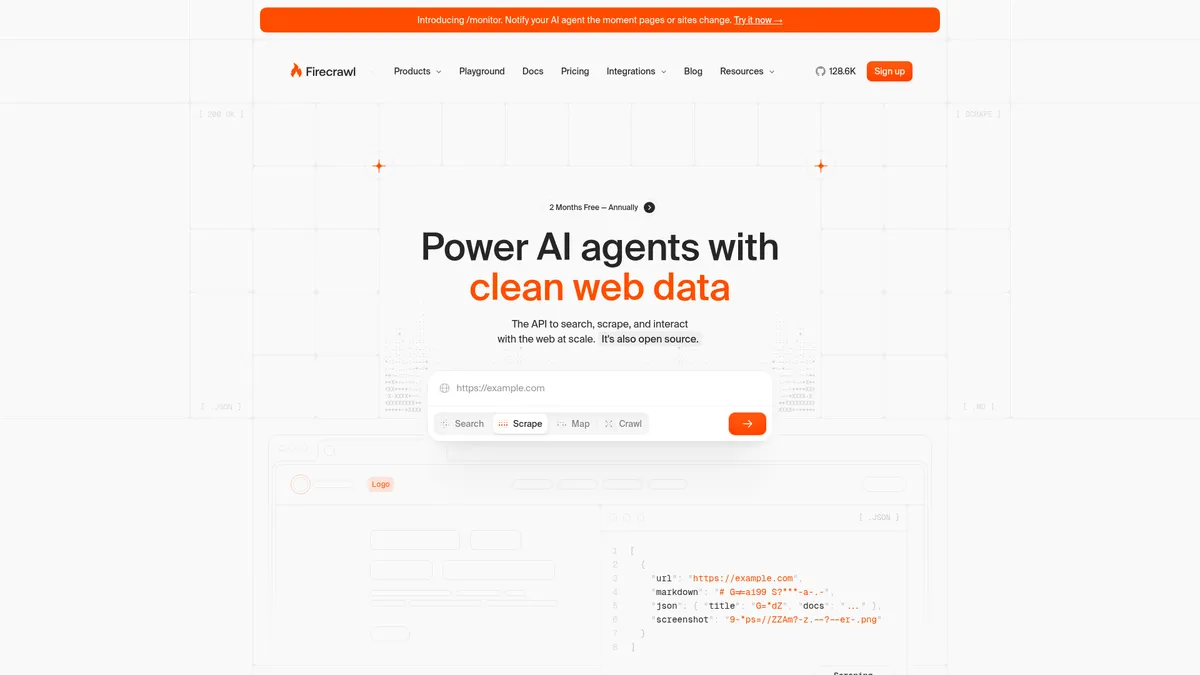
What is Firecrawl?
How to Use Firecrawl
Firecrawl makes it simple to start extracting web data for your AI applications. Here's how to get your first scrape up and running in minutes, from signing up to integrating with your AI agent.
Sign Up for a Free Account
Go to firecrawl.dev and create a free account. No credit card is required for the Free plan, which gives you 1,000 monthly credits to test the API and build prototypes.
Get Your API Key
Once logged in, navigate to the Developer Dashboard to find your unique API key. You'll use this key to authenticate all requests to Firecrawl's endpoints.
Make Your First Scrape Request
Use the Scrape API to convert any URL to Markdown. A simple cURL command returns clean, LLM-ready content. Firecrawl handles JavaScript rendering, proxy management, and content extraction automatically.
Integrate with Your AI Agent
Use Firecrawl's Python or Node.js SDK to integrate web data into your AI agent's workflow. The SDK handles authentication, rate limiting, and returns structured data that your agent can process immediately.
Set Up Monitoring (Optional)
Enable the Monitor feature on any URL to receive real-time alerts when the page content changes. This is perfect for keeping AI agents updated on competitive moves, pricing changes, or documentation updates.
Firecrawl Core Features
Firecrawl Use Cases
- 1Power retrieval-augmented generation (RAG) pipelines with fresh, clean web content. Firecrawl's Scrape API returns LLM-ready Markdown, making it simple to feed accurate, up-to-date data into your vector database without manual cleaning or formatting.
- 2Give your AI agents the ability to search, scrape, and interact with the live web autonomously. With the Monitor feature, agents stay updated on page changes in real-time, enabling proactive responses to competitive moves or content updates.
- 3Track competitor pricing, feature changes, and product launches at scale. Firecrawl's Crawl & Map feature maps entire sites and extracts structured data, while the Monitor API alerts you the moment a page changes.
- 4Keep your chatbot's knowledge fresh by automatically scraping product docs, help centers, and news sources. Firecrawl converts messy web pages into clean Markdown that RAG systems can index and retrieve instantly.
- 5Automate complex web interactions like form filling, login flows, and data submission using the Interact sandbox. Describe what you want in natural language or script it with code — no headless browser setup required.
Pros and Cons of Firecrawl
Pros
- Exceptional web coverage of 96% including JavaScript-heavy SPAs, eliminating the need for complex proxy management or headless browser setup and maintenance.
- Ultra-fast response times with P95 latency of ~3.4 seconds, making it ideal for real-time AI agent applications where every second of delay matters.
- Open-source core with a massive community of 128K+ GitHub stars ensures transparency, community contributions, continuous improvement, and vendor independence.
- Generous free tier with 1,000 monthly credits and no credit card required, allowing developers to thoroughly test the platform and build prototypes before committing.
✕ Cons
- Credits-based pricing can be difficult to estimate for unpredictable or bursty workloads, potentially leading to unexpected costs at scale without careful monitoring and budgeting.
- Lower-tier plans have strict concurrency limits (2-5 requests), which can bottleneck larger scraping or crawling projects and force an upgrade to higher-tier plans.
- Heavily protected sites with CAPTCHAs or advanced anti-scraping measures may still require custom handling despite the high 96% coverage rate, adding complexity for edge cases.
Firecrawl vs Top Alternatives
| Feature | Puppeteer | ScrapingBee | Apify |
|---|---|---|---|
| Web Coverage | JS-rendered (Chrome only) | ~85% coverage | ~90% coverage |
| Latency (P95) | Variable (page-dependent) | ~5 seconds avg | ~4 seconds avg |
| Open Source | Yes (Apache 2.0) | No | Partial (open-source actors) |
| Free Tier | Yes (free to use) | Yes (1,000 credits/mo) | Yes ($5 free credits) |
Firecrawl Pricing
Free
- 1,000 monthly credits
- 2 concurrent requests
- Basic rate limits
- Community support
- No credit card required
Hobby
- 5,000 monthly credits
- 5 concurrent requests
- Basic support
- Annual discount available
Standard
- 100,000 monthly credits
- 50 concurrent requests
- Standard support
- Annual discount available
Growth
- 500,000 monthly credits
- 100 concurrent requests
- Priority support
- Annual discount available
Scale
- 1,000,000 monthly credits
- 150 concurrent requests
- Priority support
- Annual discount available
Enterprise
- Custom credit allocation
- Custom concurrency limits
- Dedicated SLA
- SSO authentication
- Zero-data-retention option
- Dedicated support
Firecrawl FAQ
What is Firecrawl?+
How does Firecrawl's pricing work?+
Is Firecrawl open-source?+
What makes Firecrawl different from traditional web scraping tools?+
Can Firecrawl handle JavaScript-heavy websites?+
Does Firecrawl offer a free tier?+
How does the Monitor feature work?+
Firecrawl Review — Editor's Score
Who Should Use Firecrawl?
Firecrawl is ideal for AI engineers, data scientists, and full-stack developers building RAG pipelines, AI-powered chatbots, autonomous agents, or competitive intelligence tools. It's also perfect for indie hackers and startups who need a scalable web data infrastructure without managing proxies or headless browsers.
Firecrawl delivers exactly what the AI development community has been crying out for: a fast, reliable, and developer-friendly web data API that speaks the language of LLMs. Its no-proxy architecture and 96% coverage eliminate the biggest headaches of web scraping, while the generous free tier makes it a no-brainer to try. For teams building AI agents that need real-time web data, Firecrawl is currently the gold standard.
- 96% web coverage including JavaScript-heavy SPAs with no proxy management required
- Ultra-low latency with P95 response time of ~3.4 seconds for real-time AI agent use
- Open-source core with 128K+ GitHub stars and a thriving developer community
📺 Firecrawl Tutorials & Introduction
Firecrawl AI clearly explained (and how to make $$) - YouTube
Firecrawl MCP + n8n: The Ultimate Web Scraping AI Agent Tutorial
Scrape ANY Website With AI For FREE with Firecrawl ... - YouTube
Keywords: