
Dataloop
End-to-end AI development for unstructured data
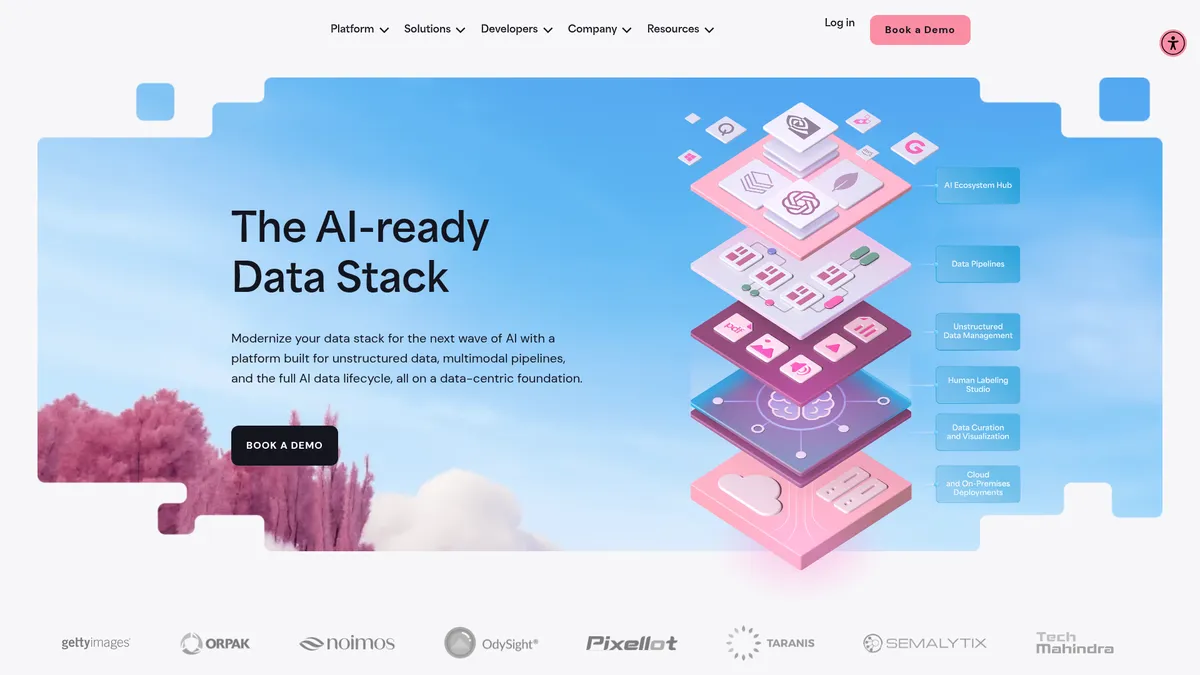
What is Dataloop?
How to Use Dataloop
Getting started with Dataloop is straightforward. This guide will walk you through creating your first project, ingesting data, and setting up a pipeline to train and deploy a model.
Create a Project
Start by creating a new project from the Dataloop dashboard to organize your datasets, models, and pipelines in one place.
Ingest Data
Upload your unstructured data (images, video, audio, text) via the web UI, API, or connect cloud storage buckets like S3 or GCS.
Preprocess and Annotate
Use automated pipelines to generate embeddings and similarity indexes, then annotate data using the built-in human feedback loop.
Train or Fine-tune a Model
Browse the model hub for pre-trained models or register your own; experiment with different versions and hyperparameters.
Deploy and Monitor
Deploy your model with one click, set up monitoring dashboards to track performance, and receive drift alerts.
Dataloop Core Features
Dataloop Use Cases
- 1Computer Vision & Autonomous Vehicles: Ingest massive video streams, auto-generate embeddings, label with human-in-the-loop, train and customize detection models for self-driving systems.
- 2Medical Imaging: Securely handle PHI with compliant pipelines, version medical datasets, and rapidly iterate on diagnostic models with full audit trails.
- 3Media & Entertainment: Automate content moderation, tagging, and generation of video/text assets using GenAI pipelines integrated with NVIDIA NIM.
- 4Manufacturing Quality Inspection: Route real-time data from IoT sensors through edge-to-cloud pipelines to detect defects and trigger alerts.
- 5Enterprise AI Operations: Centralize model registry, automate CI/CD for AI, monitor drift and performance across all production models from a single dashboard.
Pros and Cons of Dataloop
Pros
- End-to-end platform covering data ingestion, preprocessing, model training, deployment, and human feedback in a single unified interface.
- Strong security and compliance certifications including GDPR, ISO 27001, SOC 2 Type II, with RBAC, SSO, 2FA, and AES-256 encryption.
- NVIDIA NIM integration enables up to 128x faster adoption of generative AI and agentic workloads with reduced infrastructure costs.
- Marketplace of reusable components and pre-built models significantly speeds up prototyping and reduces duplicate effort across teams.
✕ Cons
- Pricing opacity – no public pricing makes budgeting difficult for small to medium businesses and requires a sales call.
- Significant learning curve due to the breadth of features; new teams may require dedicated onboarding to get up to speed.
- Vendor lock-in risk as there is no open-source or community edition, creating dependence on Dataloop's ecosystem for updates and support.
Dataloop vs Top Alternatives
| Feature | Labelbox | Scale AI | Supervisely |
|---|---|---|---|
| End-to-end platform coverage | Focuses primarily on data labeling and annotation, not full lifecycle. | Covers data labeling and model evaluation but lacks pipeline orchestration. | Open platform for computer vision but lacks GenAI and LLM support. |
| Data versioning and lineage | Offers dataset versioning but limited model management features. | Data management features exist but versioning is less comprehensive. | Projects include data versioning as part of project management. |
| Human-in-the-loop capabilities | Provides human review tools but RLHF is not natively integrated. | Includes human review but focuses on managed services rather than self-serve. | Offers annotation tools but without native RLHF integration. |
| Pricing transparency | Has transparent per-seat pricing with public plans. | Pricing is available upon request but offers standardized tiers. | Transparent pricing based on storage and compute usage. |
Dataloop Pricing
Free Trial
- Access to demo environment
- Limited data volume
- Community support
Enterprise
- Full platform access
- Dedicated support
- Custom SLA
- On-premise deployment
Dataloop FAQ
What is Dataloop?+
How does Dataloop handle data versioning?+
Is Dataloop suitable for small teams?+
What integrations does Dataloop support?+
How does Dataloop ensure data security?+
Can I use Dataloop for free?+
What programming languages does Dataloop support?+
Dataloop Review — Editor's Score
Who Should Use Dataloop?
Dataloop is ideal for large organizations and AI teams dealing with complex multimodal workloads that require robust security, compliance, and a single platform for the entire AI lifecycle.
Dataloop delivers a truly end-to-end experience for teams building AI on unstructured data. Its data-centric approach, combined with strong compliance and NVIDIA NIM integration, makes it a standout for enterprise use cases. However, opaque pricing and a steep learning curve may deter smaller teams.
- End-to-end AI lifecycle management in one platform
- NVIDIA NIM integration for 128x faster GenAI adoption
- Enterprise-grade security and compliance certifications
📺 Dataloop Tutorials & Introduction
Dataloop Tutorial for Newbiews | Dataloop Ai Platform Demo
PolyWorks DataLoop demo at Advanced Engineering - YouTube
PolyWorks|DataLoop - Data access made easy - YouTube
Keywords: